
Last Updated: October 13, 2026
Lab-Grown vs. Natural Diamonds: What the Ethics Conversation Misses
An ethical lab grown diamond jewelry guide must start with a truth: the ethics conversation around diamonds is too narrow.
Federal Trade Commission guidance on jewelry advertising and diamond terminology sets the baseline for how diamonds can be described and marketed, including the requirement that lab-grown origin be disclosed clearly.
Where the Standard Framing Falls Short
Most guides split the world into "mined equals bad" and "lab equals good." That framing collapses under scrutiny.
- Energy and carbon claims are often unverified. A stone grown on a coal-heavy grid can carry a heavier footprint than a mined one.
- Labor accountability is not automatic. Fair wages and safe conditions apply to labs just as to mining.
- The setting is part of the story. Recycled and traceable metals matter as much as the stone.
A More Useful Way to Compare
| Factor | Lab-Grown Diamonds | Mined Diamonds | What to Verify |
|---|---|---|---|
| Origin transparency | Reactor-produced, documented | Geological, mine-dependent | Grading report and origin disclosure |
| Energy source | Varies by grid and producer | Varies by mine and region | Producer's energy disclosure |
| Water use | Generally lower in production | Higher in large-scale mining | Operator environmental reporting |
| Labor conditions | Factory and lab oversight needed | Mining safety and fair wages | Supplier code of conduct |
| Metal provenance | Recycled or traceable gold | Same question applies | Metal sourcing statement |
| Resale value | Typically lower resale market | Established resale market | Current resale quotes |
Ask each supplier the same four questions; the one who answers all four is worth buying from.
Lab-Grown Diamond Certification: How to Verify Ethical Claims
Verification works in layers: a certificate proves the stone is what it claims, but not that it was produced responsibly.
How to Verify a Lab-Grown Diamond
Follow this sequence when evaluating any lab-grown diamond jewelry purchase:
- Request the grading report number and confirm it on the issuing lab's own website, not a screenshot.
- Match the report to the stone, carat weight, measurements, and inclusion plot.
- Confirm lab-grown origin is stated on the report.
- Ask for the metal sourcing statement. Recycled gold, traceable gold, and Continuum Sterling Silver are legitimate answers; "we don't know" is not.
- Ask for labor and environmental disclosure, a written code of conduct or published reporting.
- Get the return and repair policy in writing before purchase.
Reading a Grading Report Without a Gemologist
The 4Cs, cut, color, clarity, and carat weight, are the standard grading categories (gia.edu).
A grading report does not grade the setting, metal, or craftsmanship, those are judged by hand.
Gemological Institute of America guidance on diamond grading and the 4Cs explains how each grading category is assessed and why cut carries the most weight for appearance.
How to Choose a Lab-Grown Diamond: A Buyer's Framework
Start with the wearer's routine, then work backward to the stone.
A Decision Framework by Buyer Type
- Daily wear and active hands: A bezel or low-profile setting in a harder metal protects the girdle and resists snagging.
- Milestone gifts: A certified solitaire with a clear grading report carries the most verifiable value.
- Self-purchase: Buy for the stone and craftsmanship, not resale, lab-grown resale markets are still developing.
Matching Real Pieces to Real Buyers
For hands-on wearers, the Certified Round Lab Diamond Solitaire Ring in sterling silver with a bezel setting and wide band sets a certified 1ct round lab diamond in a smooth bezel on a wide polished band, sized 4 to 10 free.

For a milestone gift, the Emerald-Cut Diamond Split Shank Solitaire Ring in white gold sets a 1.5-carat certified emerald-cut lab-grown diamond in 14k white gold with a modern split shank, also sized free.

For a self-purchaser, the Lab Diamond Weave Necklace in 14K white gold carries 1/2 carat total weight of brilliant lab diamonds on an adjustable cable chain worn at 17 or 19 inches.

For a first piece or tighter budget, the Lab Diamond Stud Earrings set in Continuum Silver mountings offer 1 carat total weight in a tarnish-resistant, hypoallergenic silver alloy for daily wear.
Lab-Grown Diamond Care
Lab-grown diamonds are as hard and durable as mined stones. Clean with warm water, mild dish soap, and a soft brush; check prongs and bezels for looseness; store pieces separately; and have daily-wear settings inspected yearly.
Why the Setting and the Bench Matter
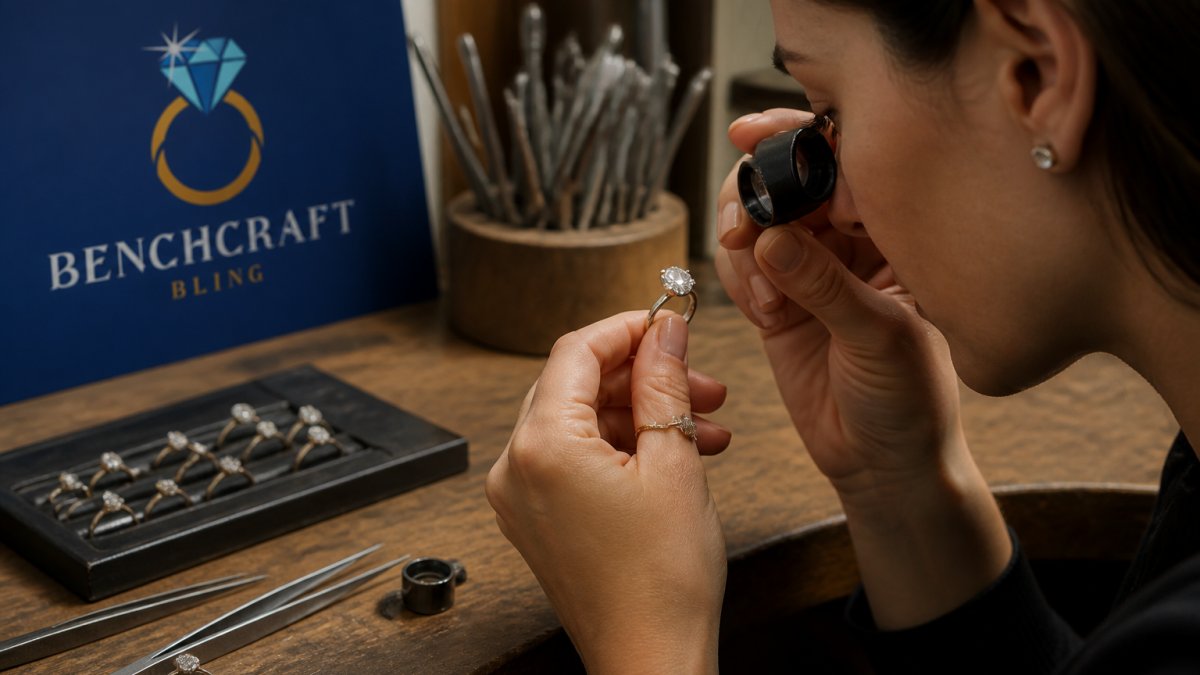
Two rings can hold identical certified stones yet feel completely different in the hand, the difference is the bench work: prong finishing, band polishing, how the stone sits.
Full Lifecycle and Resale
Lab-grown diamonds have a developing resale market; mined diamonds have a longer-established one, though resale returns are typically well below retail for both.
Choosing ethical lab grown diamond jewelry means asking harder questions: origin, energy, labor, and metal provenance are four separate conversations, and a supplier who answers all four is worth trusting. Benchcraft Bling handcrafts each piece with a master bench jeweler's 40-plus years of experience, offers certified lab-grown diamonds with grading reports, and builds jewelry designed to mix, match, and move through everyday life. Get started with Benchcraft Bling and find a piece that holds up to the way you actually wear it.