
Table of Contents
- Lab Grown Diamonds vs Mined: What Actually Differs
- How Each Diamond Is Made: HPHT vs CVD Growth Methods
- Cost and Price Difference: Why Lab Grown Diamonds Cost Less
- GIA vs IGI Diamond Grading: What the Reports Tell You
- Can a Jeweler Tell the Difference? Optical Properties and Testing
- Lab Grown Diamond Resale Value and Insurance Considerations
- How to Choose an Ethically Sourced Diamond That Fits Your Values
- The Verdict: Which Diamond Should You Buy?
- Frequently Asked Questions
Last Updated: September 8, 2026
Lab Grown Diamonds vs Mined: What Actually Differs
The debate over lab grown diamonds vs mined diamonds comes down to one central question: are they the same stone, or merely convincing lookalikes? The answer is that lab grown diamonds are chemically, physically, and optically identical to mined diamonds. Both are pure carbon arranged in the same crystal structure, scoring a 10 on the Mohs scale of hardness (mineralseducationcoalition.org). The truth is that the only reliable difference between the two is their origin story.
What most guides get wrong is framing this as a "real versus fake" argument. A lab grown diamond is not a simulant like cubic zirconia or moissanite. It is a genuine diamond with the same refractive index, dispersion, and thermal conductivity as an earth-mined stone. The difference lies entirely in how each crystal is formed, which then shapes cost, grading, and long-term value.
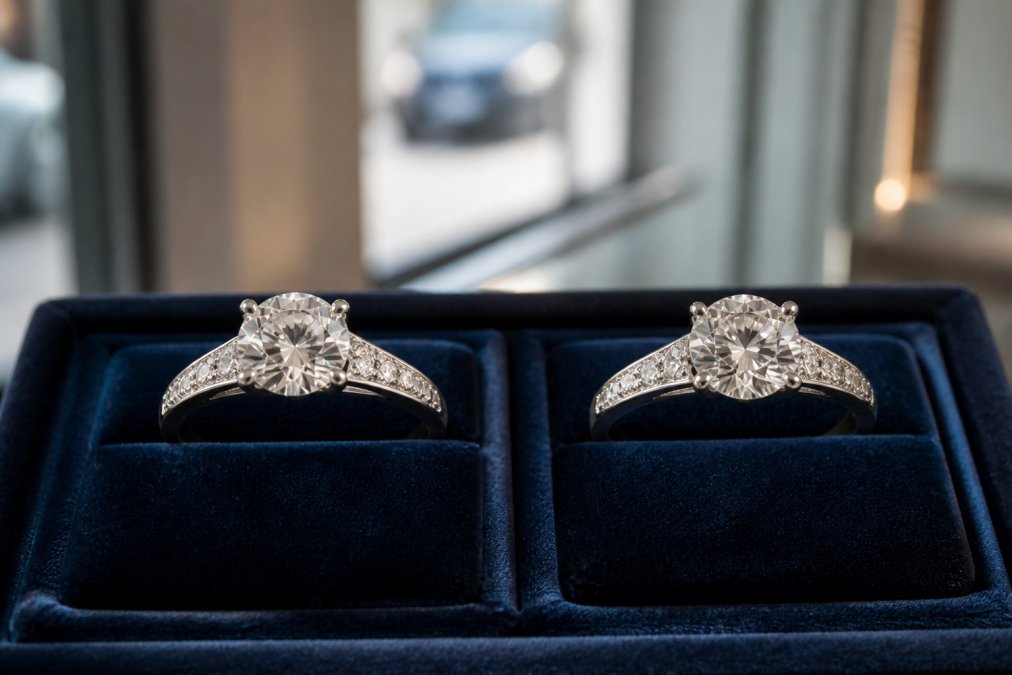
How Each Diamond Is Made: HPHT vs CVD Growth Methods
Understanding the two primary growth methods is more than a science lesson; it's a practical tool for choosing a better stone. While mined diamonds form over billions of years, lab grown diamonds are created in weeks using one of two distinct technologies: High Pressure High Temperature (HPHT) and Chemical Vapor Deposition (CVD). Each method leaves subtle fingerprints on the crystal, which can influence color, clarity, and even how the stone reacts to certain jewelry manufacturing processes.
High Pressure High Temperature (HPHT)
HPHT mimics the earth's natural conditions. A small diamond seed is placed in a press and subjected to temperatures exceeding 2,700°F and pressures of nearly 1.5 million pounds per square inch (gia.edu). This causes carbon to crystallize around the seed. The process is effective but can introduce trace elements like nitrogen or boron into the crystal lattice. Nitrogen often results in a slight yellow or brown tint, while boron can impart a blue hue. For this reason, HPHT stones may require additional treatment to achieve a higher, colorless grade. However, HPHT is also the method often used to improve the color of brownish mined diamonds.
Chemical Vapor Deposition (CVD)
CVD takes a different approach. A diamond seed is placed in a vacuum chamber filled with a carbon-rich gas, typically methane, alongside hydrogen. Microwaves or heat break down the gas molecules, and carbon atoms rain down onto the seed, building the diamond layer by layer. This process operates at lower pressures and temperatures than HPHT. CVD stones often start with higher color grades but can develop brown or gray tints if the growth process isn't carefully controlled. They may also exhibit distinctive graining patterns under magnification, which some gemologists find useful for identification.
Why the Method Matters to You
A common pattern is that HPHT stones are more likely to be type IIa, a classification for diamonds with very few nitrogen impurities, which can make them exceptionally pure. CVD stones, on the other hand, are often type IIa as well but may require post-growth treatment to remove a brownish hue. Neither method is inherently superior; the skill of the grower and the post-growth processing determine the final quality. When a seller provides a grading report, it often indicates the growth method. This detail is not trivial. If you are considering a stone for a specific setting, such as one that requires high heat during repair, the growth method can influence how the stone responds. Asking your jeweler about the growth method is a sign of an informed buyer and can help you avoid future maintenance surprises.
Cost and Price Difference: Why Lab Grown Diamonds Cost Less
The most immediate difference shoppers notice is price. Lab grown diamonds typically cost significantly less than mined diamonds of comparable quality because the supply chain is shorter and production is controlled. Rather than paying for mining operations, rarity, and a multi-step distribution network, you are paying for the technology and craftsmanship of the growth facility.
That price difference translates into tangible benefits for buyers. You can often afford a larger carat weight, a higher color grade, or a better clarity grade for the same budget. A common mistake is assuming a lower price means lower quality. In practice, the 4Cs (Cut, Color, Clarity, Carat) apply identically to both stones, and a well-cut lab grown diamond performs just as brilliantly as a mined one.
| Comparison Point | Lab Grown Diamond | Mined Diamond |
|---|---|---|
| Chemical composition | Pure carbon | Pure carbon |
| Hardness | 10 on Mohs scale | 10 on Mohs scale |
| Production time | Weeks | Billions of years |
| Typical price | Lower | Higher |
| Grading standards | GIA / IGI | GIA / IGI |
GIA vs IGI Diamond Grading: What the Reports Tell You
Professional grading is where lab grown diamonds prove their legitimacy. Both the Gemological Institute of America (GIA) and the International Gemological Institute (IGI) issue grading reports for lab grown diamonds using the exact same 4Cs framework applied to mined stones (gia.edu). A GIA report for a lab grown diamond includes the same cut, color, clarity, and carat details as a mined diamond report, with one notable addition: a laser inscription identifying the stone as lab grown.
When comparing GIA vs IGI diamond grading, the practical difference is consistency and market recognition. GIA is widely considered the most rigorous grader, particularly for cut quality. IGI is also respected and often grades a larger volume of lab grown diamonds, which some buyers find reassuring. The key is to insist on a report from either laboratory, never accept a stone without independent certification. This protects you from overpaying and confirms you are receiving exactly what the seller claims.
Can a Jeweler Tell the Difference? Optical Properties and Testing
No jeweler can tell the difference between a lab grown and mined diamond just by looking at it. The optical properties, including refractive index and dispersion, are identical. Under a standard loupe, both stones show the same fire and brilliance. Even thermal conductivity testing, which distinguishes diamonds from simulants like moissanite, cannot separate a lab grown diamond from a mined one.
The only way to confirm origin is through advanced spectroscopy at a gemological laboratory. Testing equipment analyzes trace elements and crystal growth patterns to determine whether the stone formed naturally or in a reactor. This is why the laser inscription on the girdle of a certified lab grown diamond is so important. It provides immediate proof of origin without requiring laboratory analysis.
Lab Grown Diamond Resale Value and Insurance Considerations
The financial conversation around lab grown diamonds extends beyond the initial purchase price. While the resale market for lab grown diamonds is thinner and prices are lower than mined stones, the more immediate and practical concern for most buyers is insurance. A common mistake is treating a lab grown diamond appraisal the same as a mined diamond appraisal, which can lead to overpaying on premiums or being underinsured.
The Resale Reality
Mined diamonds have a historical secondary market, but the idea that they 'hold value' is often overstated. Retail markups mean most mined diamonds resell for a fraction of their original price. Lab grown diamonds experience steeper depreciation because production can be scaled to meet demand, making the secondary market less established. A realistic perspective is to view a lab grown diamond as a consumer good, similar to a new car, that provides immediate value through its beauty and utility, rather than as a financial asset. The value you receive is in the wearing, not the reselling.
How Insurance Companies View Lab Grown Diamonds
Insurance companies are beginning to treat lab grown diamonds as a distinct category. A standard jewelry appraisal for a lab grown diamond should reflect its current replacement value, which is typically lower than a comparable mined stone. However, a common pattern is that some insurers will initially try to insure a lab grown diamond at the price of a mined diamond, leading to inflated premiums. To avoid this, you must be explicit with your insurer. Provide them with the grading report that states the stone is lab grown and the original purchase receipt. Ask for a policy that specifically covers the replacement value of a lab grown diamond, not a mined equivalent.
The Appraisal Nuance
A critical nuance is the difference between 'retail replacement value' and 'fair market value.' For insurance purposes, you want a policy that covers the retail replacement value, what it would cost to buy a similar lab grown diamond today. This figure should be based on current market prices for lab grown stones, which have been declining as technology improves. An appraisal that uses outdated pricing or benchmarks against mined diamonds will leave you either overpaying or underinsured. A reputable appraiser should be able to provide a current, accurate replacement value for your specific lab grown stone.
Practical Steps for Protection
First, obtain a grading report from a recognized laboratory like GIA or IGI that explicitly states the stone is lab grown. Second, get a separate insurance appraisal from an independent appraiser who specializes in lab grown diamonds. Third, review your policy annually, as lab grown diamond prices can change. By taking these steps, you ensure that your premium reflects the true value of your stone and that you are not caught off guard in the event of loss or damage.
How to Choose an Ethically Sourced Diamond That Fits Your Values
Sustainability claims in the diamond industry require careful scrutiny. Mined diamonds, particularly from regions without strong oversight, carry concerns about environmental footprint and conflict financing. The Kimberley Process was designed to curb conflict diamonds, but its scope is limited. Lab grown diamonds avoid mining entirely, which eliminates the associated land disruption and labor concerns. The environmental footprint of growing diamonds is real, primarily from energy use in HPHT and CVD reactors, but it is generally smaller than the impact of earth-mined extraction.
When choosing an ethically sourced diamond, ask for documentation. A reputable seller should provide a grading report from GIA or IGI that confirms the stone is lab grown, along with information about the growth facility. For those seeking conflict-free assurance with full supply chain transparency, lab grown diamonds offer a verifiable path from reactor to ring. Every lab grown diamond we set comes with clear documentation so you can wear your piece with complete confidence.
The Verdict: Which Diamond Should You Buy?
The choice between lab grown diamonds vs mined diamonds depends on your priorities. If maximizing carat size and quality within a budget matters most, lab grown diamonds are the clear winner. If you value the geological romance of a stone formed over billions of years, a mined diamond may hold sentimental appeal. Both are genuine diamonds that will last a lifetime with proper care.
Durability and maintenance are identical for both options. Diamonds are the hardest natural material, resistant to scratching and suitable for everyday wear. The settings, however, require periodic inspection to ensure prongs remain secure. A master bench jeweler with decades of experience understands how to craft settings that protect your stone through daily routines.
For most buyers, lab grown diamonds deliver superior value, ethical peace of mind, and identical beauty. The decision ultimately rests on what matters more to you: the story of the stone's creation or the story of the life you will wear it through.
Choosing between lab grown and mined diamonds no longer means compromising on quality or brilliance. Lab grown diamonds offer the same fire, durability, and craftsmanship as mined stones at a more accessible price, with verifiable ethical sourcing. Benchcraft Bling pairs these exceptional stones with handcrafted settings designed by a master bench jeweler with over 40 years of experience, creating pieces built to mix, match, and move with you through every moment. Get started with Benchcraft Bling and find a diamond that celebrates your values and your style.
Frequently Asked Questions
Are lab-grown diamonds considered real diamonds?
Yes. Lab grown diamonds are real diamonds with the same chemical composition, crystal structure, and optical properties as mined diamonds. Both are pure carbon atoms arranged in a cubic crystal structure. The only difference is origin: one forms beneath the earth's surface over millions of years, the other is grown in a laboratory over weeks. Even gemological laboratories like GIA and IGI grade them using the same 4Cs standards.
Can a jeweler tell if a diamond is mined or lab grown?
A jeweler cannot tell the difference with the naked eye or a standard loupe. Lab grown and mined diamonds look identical, including their brilliance and fire. Distinguishing them requires advanced testing equipment that examines trace elements or growth patterns. That is why GIA and IGI now include origin disclosure on grading reports, so you always know exactly what you are buying.
Do lab grown diamonds hold their resale value compared to mined diamonds?
Lab grown diamond resale value is typically lower than mined diamonds because lab grown prices have fallen as production costs dropped. However, mined diamonds also depreciate significantly once purchased, often retaining only a fraction of retail price. If resale matters to you, focus on buying a well-cut stone with a solid grading report and consider how much you value the upfront savings instead.
What are the primary ethical and environmental differences between the two?
Lab grown diamonds avoid the environmental footprint of open-pit mining, which displaces tons of earth per carat. They also eliminate concerns about conflict diamonds, though reputable mined diamond sources now follow the Kimberley Process. For an ethically sourced diamond, lab grown stones offer a transparent supply chain from reactor to finished ring. If you prefer mined, ask for provenance documentation to verify responsible sourcing.
How does the price of lab-grown diamonds compare to mined diamonds?
Lab grown diamonds typically cost 60 to 85 percent less than mined diamonds of comparable cut, color, clarity, and carat weight. That price gap has widened as growth technology improved. The savings let you buy a larger stone or invest in a higher-quality setting for the same budget. Always compare stones with identical 4Cs grades to get an accurate picture of the difference.