
Table of Contents
- The True Cost Breakdown of Handcrafted Jewelry
- Handcrafted vs Mass Produced Jewelry: What Changes the Price
- The Hidden Costs Most Buyers Never See
- The Benefits of Artisan Jewelry That Justify the Price
- How to Clean Handcrafted Gold Jewelry and Protect Your Investment
- Market Volatility, Overhead, and Small-Batch Production Costs
- Frequently Asked Questions
Last Updated: September 13, 2026
The True Cost Breakdown of Handcrafted Jewelry
Why handcrafted jewelry costs more money comes down to one uncomfortable truth: a bench jeweler's hourly rate is spread across a single piece instead of a thousand. Mass-produced jewelry is made by casting machines that stamp out identical units in minutes, so the labor cost per item is tiny. Handcrafted jewelry is made one piece at a time, by hand, with a human making decisions at every stage.
At Benchcraft Bling, every piece is shaped by a master bench jeweler with more than 40 years of experience. That experience is the product. It is also the reason the price is higher than a mall chain's.

Sterling Silver Onyx inlay Necklace . Labor and Bench Time: The Biggest Price Driver
Bench time is the single largest line item in any handcrafted piece. Setting a stone by hand, filing a bezel, polishing a clasp, and soldering a jump ring all take time that a machine skips entirely. A single pendant might pass through a jeweler's hands a dozen times before it ships.
A common mistake buyers make is comparing a handcrafted piece to a mass-produced one on materials alone. The metal costs roughly the same. The hours do not.
Raw Materials and Gemstone Sourcing
Precious metals and gemstones are priced by weight and quality, and those prices move. Gold and silver are traded commodities, so the raw materials cost changes week to week, not year to year (usgs.gov). Gemstone sourcing adds another layer: a well-cut stone with good color and clarity costs more than a commercial-grade one, and lab-grown diamonds are priced separately from mined stones even when they look identical.
Handcrafted vs Mass Produced Jewelry: What Changes the Price
The core difference between handcrafted vs mass produced jewelry is production scale. Mass-produced pieces are made from molds in large runs, which spreads tooling and setup costs across thousands of units. Handcrafted pieces are made in small-batch production, often one at a time, so every setup cost lands on a single item.
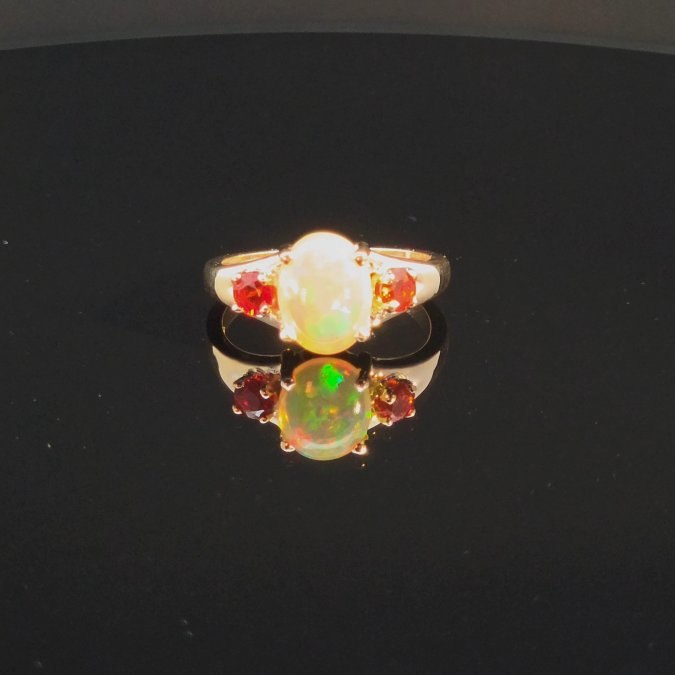
10K Opal ring
That changes three things:
- Customization: A bespoke commission can be sized, engraved, or redesigned for one customer. A mold cannot.
- Quality control: A jeweler inspects each piece by eye. A production line samples.
- Design complexity: Hand-finished details like textured bezels or sculpted prongs are labor-intensive to reproduce at scale.
The Hidden Costs Most Buyers Never See
Two costs almost never appear on a jewelry tag: waste and depreciation. Both are real, both hit small studios harder than factories, and both are baked into the price before the piece ever reaches a case. Understanding them is the fastest way to see why a handcrafted piece and a mass-produced piece with identical metal weight can carry very different price tags.
The 'Hidden' Cost of Waste
Manual fabrication is inherently More costly than industrial production. When a jeweler saws a sheet of sterling silver, files a bezel to fit a stone, or drills and reams a setting, precious metal leaves the bench as dust, filings, and offcuts. A factory casting thousands of identical units in a closed mold captures nearly all of that material and recycles it in-house. A small studio captures what it can with a bench tray and a sweeper, but a meaningful share of every piece's metal is lost to the floor, the polishing wheel, or the pickle pot.
That lost material is not free. It has to be recovered, refined, and re-purchased at the current spot price, and refining fees mean a studio rarely recoups full value on the scrap it does save. A common pattern is that hand-fabricated work carries a higher effective material cost per finished piece than cast work, even when both start from the same alloy. The customer pays for the metal that shipped and, indirectly, for the metal that did not.
Tooling and Equipment Depreciation
A factory amortizes its tooling across millions of units. A handcrafted studio amortizes it across hundreds. That difference is the whole story.
Bench jewelers rely on a deep kit of specialized tools: jeweler's saws and blades, needle files in a dozen cuts, gravers, burnishers, bezel rollers, ring benders, a rolling mill, a flex-shaft handpiece, torches and tips, soldering picks, a bench pin, a steely, and a full set of setting tools. Each has a finite life. Saw blades snap. Files dull and load. Polishing wheels and buffs wear down and must be replaced. Rolling mill rollers lose their bite. Torch tips clog and oxidize. Flex-shaft handpieces need brushes and bearings. A precision bench vise or a hydraulic press needs servicing.
None of that tooling benefits from industrial automation. There is no robot that files a bezel or sets a prong the way a hand does, so the studio cannot spread the cost of a $400 rolling mill or a $200 set of gravers across a production run of 50,000. It spreads them across the pieces it actually makes. When a tool wears out, the replacement cost lands on the next batch of work, and the customer buying from that batch pays a share of it.
Ethical Sourcing Premiums
Responsibly sourced metals and stones cost more than unverified supply chains, and that premium is built into the price. Traceable gold from a certified refiner, fair-mined or recycled metal, and stones with documented origin all carry a higher acquisition cost than commodity material of the same weight and purity. A studio that can tell you where its gold came from is paying for that paper trail. A mass-market supply chain that cannot is not.
Post-Purchase Support
Post-purchase support adds another layer. Resizing, re-polishing, stone tightening, and re-tipping prongs are services a handcrafted studio typically stands behind, which means the price of a piece includes care that a disposable mass-market item does not. When a chain store sells a ring, the transaction ends at the register. When a bench jeweler sells a ring, the relationship continues for as long as the piece is worn, and that ongoing obligation is priced in.
Why These Costs Stay Invisible
None of these line items appear on a hang tag. A mass-produced piece hides them inside a supply chain the buyer never sees. A handcrafted piece concentrates them into a single price the buyer does see, which is exactly why the handcrafted number looks higher. It is not a bigger markup. It is a more honest accounting.
The Benefits of Artisan Jewelry That Justify the Price
The benefits of artisan jewelry come down to durability, uniqueness, and investment value. A hand-finished setting holds a stone more securely than a cast-in-place one, because the jeweler tightens each prong by hand (gia.edu). A unique design will not appear on a stranger's wrist next week. And well-made pieces hold up to daily wear far longer than their mass-produced counterparts.
Benchcraft Bling builds its collection around this idea: jewelry designed to mix, match, and move with you, not sit in a box waiting for a special occasion.
Feature |
Handcrafted |
Mass Produced |
|---|---|---|
Production scale |
Small-batch |
High volume |
Stone setting |
Hand-set |
Machine-cast |
Customization |
Bespoke available |
Limited or none |
Quality control |
Per-piece inspection |
Batch sampling |
Post-purchase care |
Often included |
Rarely offered |
How to Clean Handcrafted Gold Jewelry and Protect Your Investment
Learning how to clean handcrafted gold jewelry is simpler than most people expect. Mix a few drops of mild dish soap with warm water, soak the piece for a few minutes, then work a soft-bristled brush into the settings. Rinse, pat dry with a lint-free cloth, and store it separately so it does not scratch against other pieces.
Skip ultrasonic cleaners and harsh chemicals on handcrafted pieces with set stones. The vibration can loosen a hand-tightened prong. Bring the piece to a jeweler for a professional check once a year.
Market Volatility, Overhead, and Small-Batch Production Costs
Market volatility hits handcrafted studios hardest because they cannot buy in bulk to lock in prices. When gold or silver prices shift, a small studio absorbs the change on the next order. Overhead costs add more: rent, insurance, tools, utilities, and the time spent on design that never becomes a sellable piece. Small-batch production means those fixed costs spread across fewer units, so each piece carries a bigger share.
Why Spot-Price Timing Matters More for Small Studios
Precious metals trade on global commodities markets, and the spot price moves daily. A large manufacturer buys metal in volume, often on contract, and can ride out short-term swings because its inventory covers months of production. A small studio typically buys in smaller lots, more often, at whatever the spot price happens to be that week, plus a dealer premium and, in many cases, shipping and insurance on the metal itself.
That timing gap is a real cost. If silver spikes the week a studio restocks, every piece made from that batch carries the higher metal cost. The studio cannot retroactively re-price work already quoted, and it cannot wait indefinitely for a dip without stalling production. The result is that handcrafted pricing tends to track spot prices more closely and more immediately than mass-market pricing does.
The Fixed-Cost Math of Small-Batch Production
Overhead is where the scale gap becomes arithmetic. A studio's fixed costs do not shrink just because it made fewer pieces this month. Consider what a working bench studio carries regardless of output:
- Rent or mortgage on a secure workspace, plus utilities and climate control
- Insurance, jewelers' block or a comparable policy covering inventory, tools, and liability
- Tools and consumables, saw blades, files, solder, flux, polishing compounds, burs, and drill bits
- Equipment maintenance, torch servicing, flex-shaft repairs, rolling mill upkeep
- Software and bookkeeping, design software, invoicing, inventory, and tax preparation
- Marketing and photography, the cost of showing the work to anyone at all
- Design and prototyping time, hours spent on pieces that never sell, which still have to be paid for by the pieces that do
Now divide that total by the number of pieces sold. A factory dividing the same categories across tens of thousands of units gets a per-unit overhead figure in the cents. A studio dividing them across a few hundred pieces gets a per-unit figure in the tens or hundreds of dollars. The fixed costs are not larger in absolute terms, they are simply spread across far fewer units.
The Design Time Nobody Bills For
One overhead line deserves its own note: design and prototyping. A bench jeweler sketches, carves, casts, files, and refines a piece before a single sellable unit exists. Every failed prototype, every rejected stone setting, every redesign is time that produced no revenue. A factory amortizes that same design work across a full production run. A studio amortizes it across the pieces that actually make it to market, and the ones that do not.
What the Price Actually Buys
That is the trade-off. You are paying for a person's time, skill, and judgment, not a factory's output. The metal is a commodity. The hours, the tooling, the insurance, the design time, and the service after the sale are not. When you compare a handcrafted price to a mass-produced one, you are not comparing two markups on the same cost base. You are comparing two entirely different cost structures, one built for volume, one built for a single piece at a time.
Frequently Asked Questions
Is handmade jewelry more expensive than mass-produced alternatives?
Yes, and the gap comes down to how each is made. Mass-produced pieces spread tooling, labor, and material costs across thousands of identical units, so each one carries a tiny fraction of the setup expense. Handcrafted jewelry is built one piece at a time. A bench jeweler may spend hours on setting, finishing, and quality control for a single item. That bench time, plus higher material grades and lower production volume, is why handcrafted jewelry costs more money upfront. The trade-off is durability, uniqueness, and repair options that mass-produced pieces rarely offer.
What factors contribute to the higher price of artisan-made jewelry?
Five factors drive most of the cost: skilled labor and bench time, raw material quality, production scale, overhead costs, and market volatility in precious metals and gemstones. A master jeweler's 40 years of experience means faster, cleaner work, but that expertise still commands higher hourly rates than assembly-line labor. Add ethical sourcing premiums, tooling depreciation, and the waste inherent in hand-fabrication, and the price reflects real expenses rather than a brand markup.
Does the use of ethically sourced materials increase the cost of jewelry?
It often does. Traceable gemstones and recycled or responsibly mined precious metals carry certification and audit costs that untracked supply chains avoid. Lab-grown diamonds offer a middle path: they are chemically identical to mined stones, cost less per carat, and sidestep the ethical concerns of unknown origins. For buyers who care about provenance, that premium buys documentation and peace of mind, not just a prettier stone.
Why does custom jewelry require a higher investment than off-the-shelf pieces?
A bespoke commission starts with design time: sketches, CAD models, and wax carvings before any metal is cut. The jeweler cannot reuse that work across other orders, so the full design and fabrication cost lands on one piece. Off-the-shelf jewelry amortizes design across an entire production run. Custom work also includes fittings, revisions, and a final quality check that standardized manufacturing skips. You pay for a one-of-a-kind result, and the pricing reflects that exclusivity.