
Table of Contents
- The Rules of Mixing Gold and Silver Jewelry
- How to Layer Necklaces Without Tangling
- Can You Wear Gold and Silver Rings Together?
- Styling Mixed Metal Jewelry for Beginners
- Mixing Metals by Skin Undertone
- Matching Metal Finishes: Matte vs. Polished
- Choosing a Focal Point or Statement Piece
- Balancing Visual Weight in a Stack
- The Role of Watches in Mixed Metal Looks
- How to Transition from All-Gold to Mixed
- Budget-Friendly Mixing and Metal Care
- Frequently Asked Questions
Last Updated: September 23, 2026
The Rules of Mixing Gold and Silver Jewelry
The old rule against mixing gold and silver is dead, when you mix gold and silver, only balance and intent remain. Repeat each metal at least twice, pick a dominant metal, match the finish, and anchor the look with one focal piece.
How to Layer Necklaces Without Tangling
The fix for tangling is a length plan: give each chain at least a two-inch gap from the one above it. A simple stack: 16-inch chain, 18-20 inch chain, and a 22-24 inch pendant, heaviest closest to your body, alternating metals, gold, silver, gold.
Can You Wear Gold and Silver Rings Together?
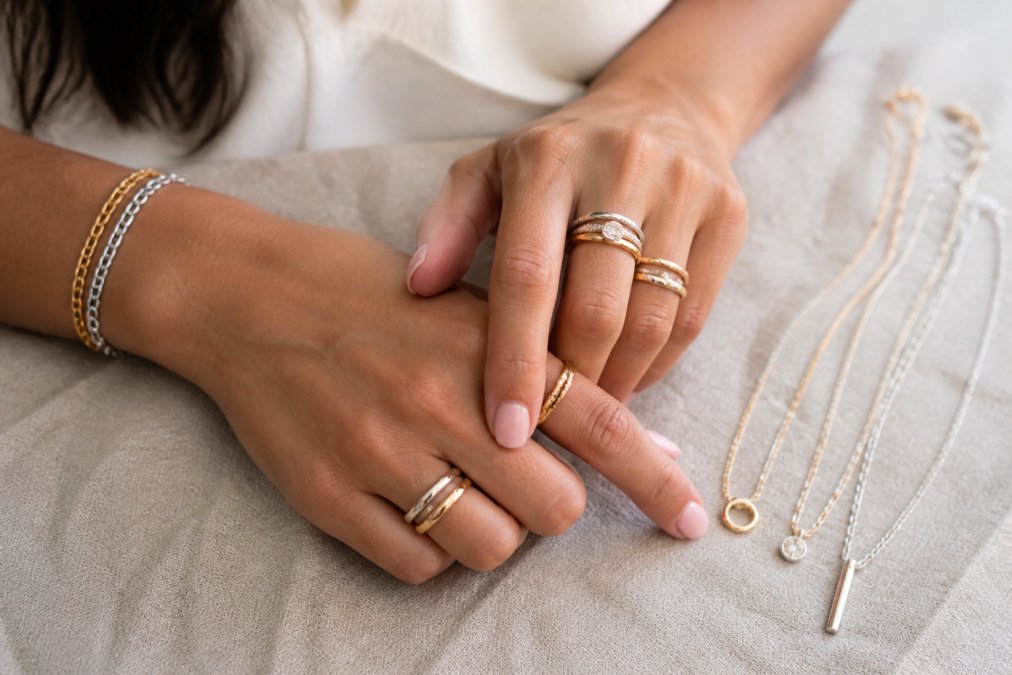
Yes, rings are the easiest start. Gold on one hand and silver on the other reads as intentional.
Keep stacked band widths close: a 2mm band next to a chunky signet looks unbalanced, while three thin alternating bands look collected.
The Gemological Institute of America's guide to jewelry metals explains how each metal behaves over time, which matters when pieces sit against each other all day.
Styling Mixed Metal Jewelry for Beginners
Start with two pieces: one gold and one silver item you already love, worn together for a week before adding more. A good starter formula: one gold chain, one silver chain, one gold ring, one silver ring, and one watch that ties both tones together.
FTC guidance on jewelry marketing claims is worth a read if you shop online, since terms like "gold plated" and "solid gold" mean very different things.
Mixing Metals by Skin Undertone
Let undertone guide which metal leads: cool leans silver, white gold, and platinum; warm leans yellow and rose gold. Check inner-wrist veins in natural light: blue-ish is cool, green-ish is warm, a mix is neutral. Undertone is a starting point, not a cage.
Matching Metal Finishes: Matte vs. Polished
Finish matters as much as color: a matte gold band next to a high-polish silver chain clashes regardless of the metals. Match finishes for a cohesive look; mix them when contrast is the point.
Your Goal |
Finish Choice |
Why It Works |
|---|---|---|
Subtle everyday look |
All polished or all matte |
Tones blend instead of compete |
Statement look |
One matte, one polished |
Contrast draws the eye |
Vintage feel |
All matte or brushed |
Softens the shine |
Choosing a Focal Point or Statement Piece
Every mixed look needs one leading piece; without it the stack looks busy. Make it a pendant, bold cuff, or wide band, and build everything else around it in quieter tones and smaller sizes.
Balancing Visual Weight in a Stack
Balance is about size, not color: a heavy cuff on one wrist and a thin chain on the other looks lopsided. Put your heaviest piece at the center, keep the sides smaller, and remove one item if it feels crowded.
The Role of Watches in Mixed Metal Looks
A two-tone watch is the easiest shortcut: it already contains both metals and bridges everything else. If your watch is one tone, treat it as your dominant metal and let other pieces follow, a silver watch with gold rings works once you add one more gold piece.
How to Transition from All-Gold to Mixed
Don't swap everything at once: add one silver piece to your gold lineup and wear it for a week. Start small, a thin silver ring, chain, or hoops, then add a second silver piece once it feels normal.
Budget-Friendly Mixing and Metal Care
You don't need fine pieces in both metals: sterling silver and gold-filled mix well with solid gold at a distance.
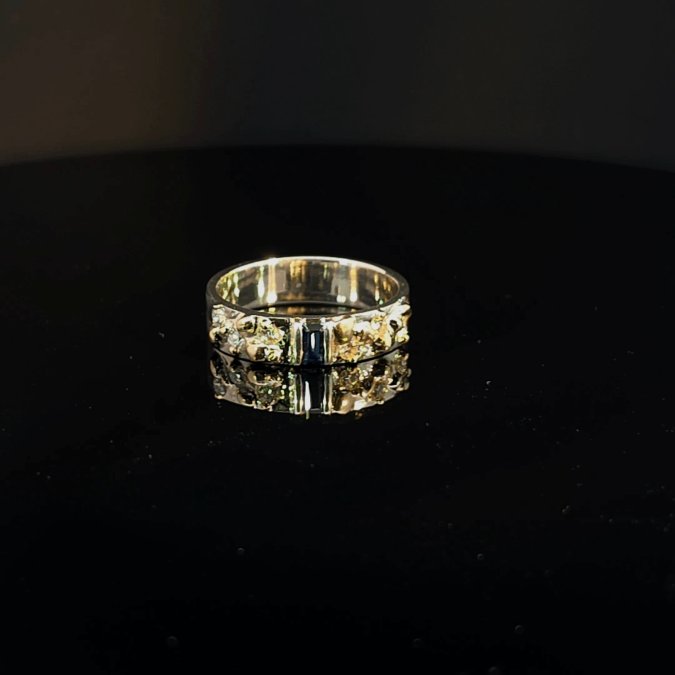
At Benchcraft Bling, our pieces are made to mix gold and silver, match, and move with you. Our Men's Lab Diamond Nugget Band, Continuum Silver & 14K Yellow Gold pairs Continuum Sterling Silver with 14K yellow gold in one band, so both tones are built in. The Continuum Silver is harder than traditional sterling, nickel-free, and hypoallergenic, a solid everyday ring, with free sizing on request.
Frequently Asked Questions
Can you wear 14k gold and sterling silver together?
Yes. 14k gold and sterling silver are both durable enough to wear together daily. The main thing to watch is wear on plated pieces, since friction can eventually rub plating thin. Solid metals like 14k gold and sterling silver won't damage each other. Just keep them dry and store them separately to slow tarnish on the silver.
How do I balance mixed metals in my everyday jewelry collection?
Pick one metal as your base and use the other as an accent. If most of your wardrobe staples lean gold, make gold your anchor and add silver in smaller pieces like a thin ring or single chain. Aim for roughly 70/30 so the mix reads intentional rather than accidental. One piece that combines both metals, like a two-tone band, ties the look together.
Does mixing metals look intentional or messy?
It reads intentional when there's a repeatable pattern. Repeating one metal in at least two spots, such as gold earrings plus a gold ring, gives the eye an anchor. Clashing happens when tones are scattered randomly across too many pieces with no focal point. Choosing a statement piece first and building around it keeps the look cohesive.
Mixing metals takes a little practice, and the first few tries rarely look perfect. Start with two pieces you already own and build slowly from there. If you want pieces made to work together from day one, Benchcraft Bling handcrafts jewelry with over 40 years of bench jeweler experience behind every design. Shop the collection and find your mix.