
Last Updated: September 25, 2026
How to Inspect Jewelry Prongs and Settings with a Jeweler's Loupe
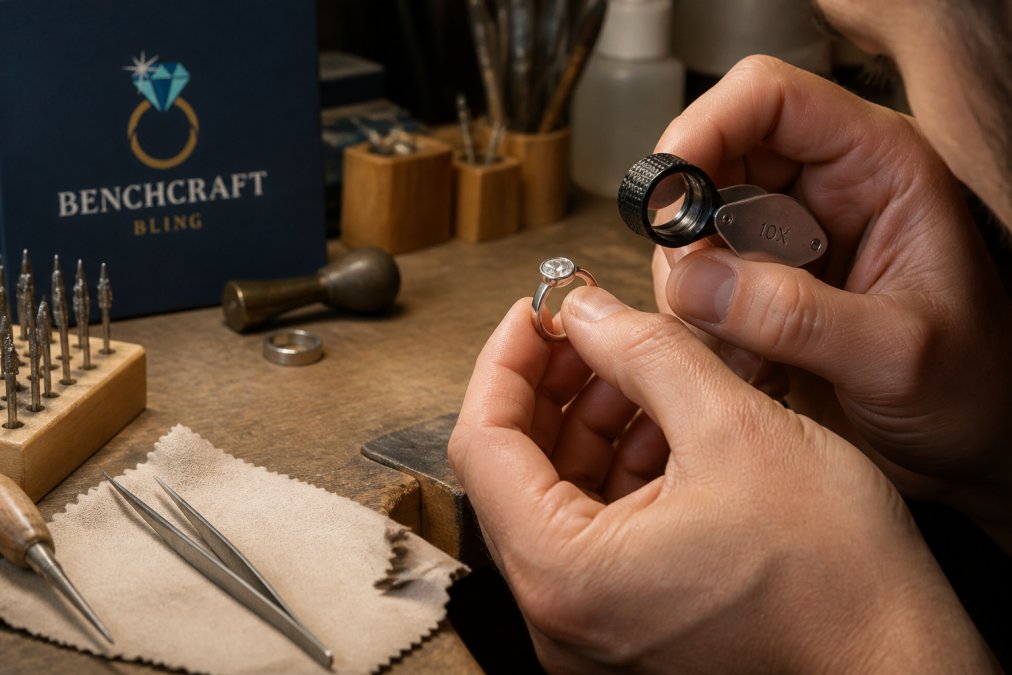
What should you check first on a prong setting?
Start with prong tips: each should be rounded, even, and seated against the stone's crown. Then check the bezel setting, a rim of metal wrapping the stone's edge, it should be smooth and continuous, holding more securely than prongs.

How do you test stone alignment and security?
Press gently with a fingernail; a secure stone doesn't move, and a tilted one catches on clothing and loosens.
Signs of Poor Quality Jewelry: Solder Marks, Casting Defects, and Inconsistent Polish
Signs of poor quality jewelry show up in the joints, surface, and polish. Solder marks are gray, lumpy patches where good soldering leaves a smooth seam; casting defects include porosity and thin walls; inconsistent polish shows as wavy reflections or scratches.
| Problem | What You See Under 10x | Why It Matters |
|---|---|---|
| Solder marks | Gray or lumpy joints | Cracks under stress |
| Casting porosity | Tiny pits in the metal | Weakens the structure |
| Thin prong tips | Flat or worn claws | Stone falls out |
Hand-Forged vs Cast Jewelry Settings: Why the Difference Shows Over Time
Hand-forged vs cast jewelry settings differ in how metal forms: cast settings are poured into molds, while hand-forged ones are shaped from solid metal, giving a denser grain structure that resists bending. Pre-made settings built to standard sizes leave an off-spec stone loose or tilted; Benchcraft Bling's handcrafted pieces are shaped around the actual stone.
How do you spot a hand-forged setting?
Look for tool marks following the metal's curve and subtle variation in thickness; cast settings look identical piece to piece.
Beyond the Loupe: Longevity, Repairability, and Digital Verification
Wear-and-tear longevity testing means checking prong tips, a ring's shank, and a necklace's clasp, thin metal there wears through first. Repairability assessment matters most: a tension setting is hard to repair, while a channel setting or flush setting is easier. Digital verification of authenticity means asking for a karat stamp or hallmark and a stone certificate with close-up photos.
How to Evaluate Product Descriptions Before You Buy
Good descriptions name the setting type, metal, and stone, and show the piece under magnification.
- Named setting type: "bezel," "prong," "channel," or "flush," not just "gold ring"
- Metal specifics: "14K white gold" or "sterling silver," not "gold tone"
- Stone details: carat weight, cut, lab-grown or mined
- Close-up photos: prongs, finish, and hallmark
- Sizing and service info: whether it can be resized or repaired